
Introduction
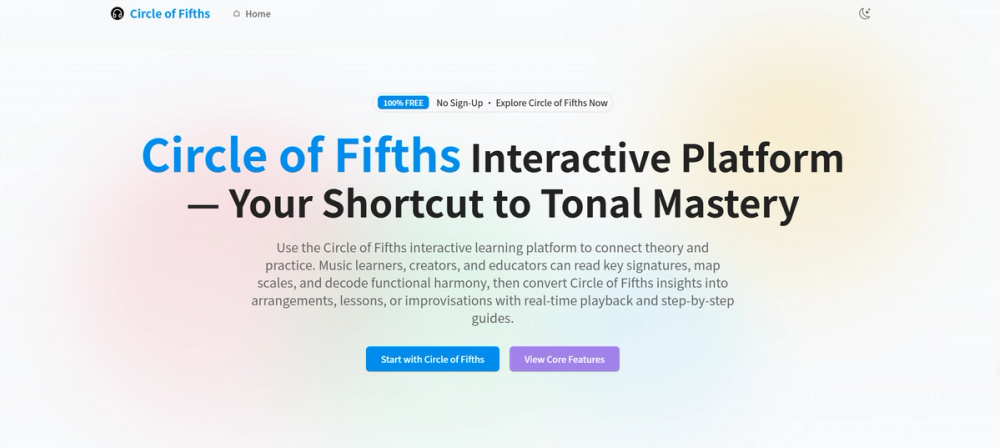
Circle of Fifths is presented through its public site as Circle of Fifths Interactive Chart & Tool | Circle of Fifths | Master key signatures, chord progressions & music theory with our interactive Circle of Fifths tool. Visualize modulation, hear chords instantly, and learn faster. Start exploring now! | Circle of Fifths Interactive Platform - Your Shortcut to Tonal Mastery | Map the Framework of the Circle of Fifths | Why Musicians Prefer Our Circle of Fifths Tool. The clearest reader value is the ability to understand the product's visible positioning from the homepage and decide whether it fits a practical evaluation need. A careful buyer or user should review Circle of Fifths directly and verify unclear details such as pricing, support, technical limits, and data sources before depending on it.
Key Features
- Master key signatures, chord progressions & music theory with our interactive Circle of Fifths tool. Visualize modulation, hear chords instantly, and learn faster. Start exploring now!
- Circle of Fifths Interactive Platform - Your Shortcut to Tonal Mastery
- Map the Framework of the Circle of Fifths
- Why Musicians Prefer Our Circle of Fifths Tool
- Interactive Circle Highlighting
- Instant Playback Across Instruments
Use Cases
Circle of Fifths appears useful for readers who need a quick way to evaluate a design tool option and decide whether the public offer matches their workflow. The visible page copy gives enough context for an initial review, but it should not replace product testing or direct confirmation of operational details.
For teams comparing tools, Circle of Fifths can be added to a shortlist when its visible positioning matches the problem they are trying to solve. A practical evaluation should start with the main public claims, then confirm whether the product supports the exact use case, team size, region, language, or technical environment required.
The available site signals suggest a design tool context, so use cases should stay close to that category rather than assuming unrelated workflows. If the product will be used in a professional or client-facing setting, readers should verify reliability expectations, support routes, and any limits that are not described on the homepage.
Pricing
The public page includes pricing-related signals: Home Circle of Fifths 100% FREE No Sign-Up • Explore Circle of Fifths Now Circle of Fifths Interactive Platform - Your Shortcut to Tonal Mastery Use the Circle of Fifths interactive learning platform to connect theory and practice. Music learners, creators, and educators can read key signatures, map scales, and decode functional harmony, then convert Circle of Fifths insights into arrangements, lessons, or improvisations with real-time playback and step-by-step guides. Whether you are sight-reading, arranging accompaniment, or a theory class, the Circle of Fifths provides clearly defined workflows. We curate popular Circle of Fifths scenarios-identifying key signatures, planning progressions, preparing modulations, analyzing classics-and pair them with exercises and audio examples for repeatable practice. Why Choose Us Why Musicians Prefer Our Circle of Fifths Tool Static charts cannot match a responsive Circle of Fifths experience. We focus on real search intent: key signature lookup, chord progression planning, and modulation strategy. By blending Circle of Fifths visuals, instant playback, and contextual prompts, learners move from theory comprehension to reliable creation and teaching outcomes. Readers should still verify current plan limits, renewal terms, account requirements, and whether any usage-based restrictions apply before committing.
User Experience and Support
The public page is scan-friendly enough for a first-pass review because it exposes the product name, page title, headings, and short descriptive copy. That is useful for visitors who want to understand the basic promise before investing time in deeper evaluation.
Support-related signals are visible on the site: Home Circle of Fifths 100% FREE No Sign-Up • Explore Circle of Fifths Now Circle of Fifths Interactive Platform - Your Shortcut to Tonal Mastery Use the Circle of Fifths interactive learning platform to connect theory and practice. Music learners, creators, and educators can read key signatures, map scales, and decode functional harmony, then convert Circle of Fifths insights into arrangements, lessons, or improvisations with real-time playback and step-by-step guides. 2 How do I avoid mechanical chord loops? 3 Does the Circle of Fifths work for non-keyboard instruments? 4 How can Circle of Fifths support teaching or group projects? Experience the Circle of Fifths Platform Now Turn theory into confident performance. Explore Circle of Fifths relationships, craft a signature sound, and elevate every rehearsal or class session. 100% FREE No Sign-Up • Explore Circle of Fifths Now Circle of Fifths Interactive Platform - Your Shortcut to Tonal Mastery Use the Circle of Fifths interactive learning platform to connect theory and practice. Music learners, creators, and educators can read key signatures, map scales, and decode functional harmony, then convert Circle of Fifths insights into arrangements, lessons, or improvisations with real-time playback and step-by-step guides. Start with Circle of Fifths View Core Features Introduction Map the Framework of the Circle of Fifths The Circle of Fifths arranges all twelve keys in perfect-fifth order. Moving clockwise adds sharps, counterclockwise adds flats, while color-coded rings highlight major keys outside and relative minors inside. Our platform combines Wikipedia insights with flows from Muted.io, offering step-by-step guidance so every learner can decode Circle of Fifths theory and transform it into practical music decisions. Circular Structure and Interval Logic Within the Circle of Fifths, opposite keys form tritone tension, illustrating how tonic, dominant, and subdominant functions cycle across pure fifths and fourths. Switching to the Circle of Fourths view reveals contrasts between cadence logic and improvisation paths, making interval movement inside the Circle of Fifths intuitive. Relative and Parallel Key Synergy The inner ring of the Circle of Fifths highlights each major key's relative minor and parallel minor, helping you compare melodic phrasing and harmonic borrowing. Tooltips show shared chords and common borrowed-tone tricks so Circle of Fifths users can attempt modal interchange without breaking tonal coherence. Typical Workflows and Case Studies Whether you are sight-reading, arranging accompaniment, or a theory class, the Circle of Fifths provides clearly defined workflows. We curate popular Circle of Fifths scenarios-identifying key signatures, planning progressions, preparing modulations, analyzing classics-and pair them with exercises and audio examples for repeatable practice. Why Choose Us Why Musicians Prefer Our Circle of Fifths Tool Static charts cannot match a responsive Circle of Fifths experience. We focus on real search intent: key signature lookup, chord progression planning, and modulation strategy. By blending Circle of Fifths visuals, instant playback, and contextual prompts, learners move from theory comprehension to reliable creation and teaching outcomes. Interactive Circle Highlighting Select any key on the Circle of Fifths to reveal signatures, scale degrees, and functional harmony tags. Neighboring keys glow to demonstrate tonal proximity, letting beginners memorize the twelve-key landscape through repeated visual exposure inside the Circle of Fifths. Instant Playback Across Instruments Trigger piano or guitar voicings directly from the Circle of Fifths panel. Hear single notes, scales, or full chords to internalize tonal color, then verify progression direction before committing to a composition or lesson plan. Scenario-Based Learning Suggestions For songwriting, live improvisation, or classroom demos, the Circle of Fifths provides tailored views with lyric ideas, groove hints, and accompaniment templates. Favorite keys are saved, generating personal review tasks so practice stays consistent. Teacher Collaboration Workspace Educators can design annotated Circle of Fifths lessons, mark pivotal chords, assign modulation drills, and track student progress. Learners see synchronized notes in real time, turning Circle of Fifths collaboration into an organized studio or classroom workflow. How to Use Four Steps to Master the Circle of Fifths Our Circle of Fifths roadmap breaks theory into repeatable tasks, guiding users from identification to application. Each stage includes interactive cues, practice prompts, and audio verification so the Circle of Fifths becomes a long-term creative habit. 1 Locate the Primary and Neighboring Keys Tap a target key or type a chord sequence. The Circle of Fifths locks the chosen major or minor key, then highlights adjacent keys and shared chords to prepare for progression design or modulation planning. 2 Switch Views to Compare Relationships Toggle among relative minors, parallel modes, and the Circle of Fourths. Compare shared tones, mark pivot chords, and plan chorus modulations with the Circle of Fifths acting as a live tonal compass. 3 Build Progression Frameworks The Circle of Fifths lists diatonic chords with functional labels plus extension tips. Drag to assemble progressions, then store them as reusable templates for collaboration or DAW export. 4 Audition, Refine, and Export Play individual chords or entire loops for instant feedback. Export MIDI, chord charts, or class handouts straight from the Circle of Fifths workspace to accelerate composition and teaching deliverables. Circle of Fifths Feature Modules We built four essential modules around real user needs-Circle of Fifths visualization, key signature recognition, chord progression design, and tonal practice-so musicians can learn, create, and teach with confidence. Key Signature & Scale Hub The Circle of Fifths hub shows signature sequences, scale tones, and fretboard hints. Search by accidental count or tonic to locate the right key instantly and prepare instrument-specific fingerings. Progression Generator Input a groove or style, and the Circle of Fifths recommends classics such as I-V-vi-IV or ii-V-I. Compare substitutions, analyze tension, and understand how each Circle of Fifths pathway resolves. Modulation Roadmap Visualize modulation routes inside the Circle of Fifths, complete with shared chords, pivot strategies, and stepwise modulation tips. Plan key changes for bridges, finales, or cinematic cues without losing coherence. Practice & Assessment Center Quiz yourself on key signatures, attempt ear training drills, or accept composition challenges. The Circle of Fifths tracker logs accuracy and fluency to document long-term progress. Circle of Fourths View Read the Circle of Fifths counter-clockwise to access fourth-based progressions common in blues (I-IV-V) and jazz (ii-V-I). Study cadence contrasts and instantly compare fourth and fifth pathways. Audio Preview & Playback Audition scales, single chords, and entire loops for instant feedback. Combine Circle of Fifths visuals with audio reinforcement to internalize each tonal color before exporting ideas. FAQ Common Circle of Fifths Questions We answer four frequent questions from beginners, creators, and educators to connect Circle of Fifths theory with everyday music tasks. 1 What problems does the Circle of Fifths solve? 2 How do I avoid mechanical chord loops? 3 Does the Circle of Fifths work for non-keyboard instruments? 4 How can Circle of Fifths support teaching or group projects? Experience the Circle of Fifths Platform Now Turn theory into confident performance. Explore Circle of Fifths relationships, craft a signature sound, and elevate every rehearsal or class session. Launch Circle of Fifths Practice Circle of Fifths Circle of Fifths is an interactive music theory learning platform that helps musicians, composers, and educators master key signatures, chord progressions, and tonal relationships. Understand the circle chart, build diatonic chords, and design harmonic progressions with our visualization tool. Evaluators should still confirm response channels, documentation depth, and onboarding help for their own use case.
Technical Details
Technical signals visible on the public page include: Home Circle of Fifths 100% FREE No Sign-Up • Explore Circle of Fifths Now Circle of Fifths Interactive Platform - Your Shortcut to Tonal Mastery Use the Circle of Fifths interactive learning platform to connect theory and practice. Music learners, creators, and educators can read key signatures, map scales, and decode functional harmony, then convert Circle of Fifths insights into arrangements, lessons, or improvisations with real-time playback and step-by-step guides. Introduction Map the Framework of the Circle of Fifths The Circle of Fifths arranges all twelve keys in perfect-fifth order. Moving clockwise adds sharps, counterclockwise adds flats, while color-coded rings highlight major keys outside and relative minors inside. Our platform combines Wikipedia insights with flows from Muted.io, offering step-by-step guidance so every learner can decode Circle of Fifths theory and transform it into practical music decisions. Whether you are sight-reading, arranging accompaniment, or a theory class, the Circle of Fifths provides clearly defined workflows. We curate popular Circle of Fifths scenarios-identifying key signatures, planning progressions, preparing modulations, analyzing classics-and pair them with exercises and audio examples for repeatable practice. Teacher Collaboration Workspace Educators can design annotated Circle of Fifths lessons, mark pivotal chords, assign modulation drills, and track student progress. Learners see synchronized notes in real time, turning Circle of Fifths collaboration into an organized studio or classroom workflow. The site does not fully explain implementation details, data sources, or operational limits, so technical evaluators should verify those points directly.
Pros and Cons
Pros
- The public page gives enough information to identify the product's broad purpose.
- The homepage can serve as a simple starting point for evaluation.
- Visible headings and descriptive copy help readers understand the product context quickly.
- The product can be assessed from public materials before a deeper trial.
Cons
- Pricing and plan boundaries may need direct verification.
- Support and documentation routes are not always clear from the visible page copy.
- Technical depth, integrations, and operational limits may require further checking.
- The page should not be treated as proof of performance, reliability, or outcomes without additional validation.
FAQ
What is Circle of Fifths?
Circle of Fifths is presented on its public website as Circle of Fifths Interactive Chart & Tool | Circle of Fifths. The page describes it as: Master key signatures, chord progressions & music theory with our interactive Circle of Fifths tool. Visualize modulation, hear chords instantly, and learn faster. Start exploring now!
Who is Circle of Fifths suited for?
It appears suited for users or teams evaluating tools in the design tool category. The right fit depends on the reader's workflow, expected feature depth, budget, and need for support or integrations.
What can users verify from the public page?
Users can verify the product name, homepage, title, visible headings, and the descriptive claims shown on the site. Visible headings include Circle of Fifths Interactive Platform - Your Shortcut to Tonal Mastery, Map the Framework of the Circle of Fifths, Why Musicians Prefer Our Circle of Fifths Tool, Interactive Circle Highlighting.
Does Circle of Fifths publish pricing information?
The page includes some pricing-related language, but readers should confirm current plans and restrictions before purchasing or adopting it.
What support or documentation should buyers look for?
Buyers should look for help docs, onboarding material, contact options, tutorials, and troubleshooting guidance. These details matter if Circle of Fifths will be used regularly rather than tested once.
What technical questions should evaluators ask?
Evaluators should ask whether Circle of Fifths supports the platforms, integrations, exports, APIs, data sources, and operational limits they need. The visible page copy should be treated as a starting point, not a complete technical specification.
What is the main limitation of evaluating Circle of Fifths from the public page?
The main limitation is that public homepage copy rarely explains every practical detail. Readers should verify pricing, support, technical constraints, update frequency, and real workflow fit before relying on the product.
Conclusion
Circle of Fifths is worth reviewing when its public positioning matches the problem a reader is trying to solve. The page provides a useful starting point, but the stronger evaluation comes from checking current pricing, support, technical details, and workflow fit on the official site before making a decision.