
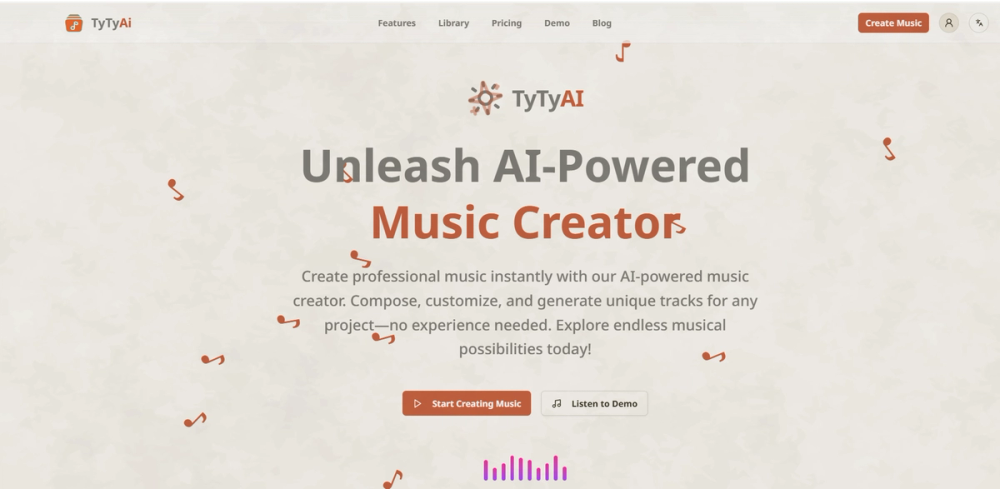
Tytyai Review
Introduction
Tytyai is presented as an AI music creation platform for generating songs, tracks, and compositions from prompts. Based on the public site, the product focuses on fast music generation, genre flexibility, prompt-driven composition, and collaborative creative workflows for people who want to make music without relying entirely on traditional production tools.
The positioning is straightforward: Tytyai aims to lower the barrier to music creation while still giving users some control over direction and style. Instead of asking users to build everything manually, it frames AI as the engine for drafting musical ideas quickly and turning creative prompts into playable tracks.
Key Features
- AI-powered music composition built around prompt-based generation.
- Fast generation positioning, with the site stating that tracks can be created in seconds and demo songs were generated in under 120 seconds.
- Support for multiple music genres, from classical to electronic styles.
- Creative control through prompt refinement and optimization.
- A library, demo area, and pricing section visible in site navigation.
- Collaboration-oriented messaging that suggests users can share, edit, and work with others in real time.
Use Cases
Tytyai appears best suited to creators who want to move from idea to music draft quickly. A content creator, indie developer, or marketer could use it to generate background music, concept tracks, or prototype compositions without waiting on a full traditional production workflow. The site strongly emphasizes speed, which makes rapid experimentation one of its most obvious use cases.
It also looks useful for users who want to explore different genres and prompt variations before committing to a final direction. The homepage highlights multiple styles and shows examples based on different prompt moods and themes. That suggests a workflow where users can test musical concepts, compare outputs, and iterate creatively.
Another plausible use case is collaborative drafting. The site states that teams can share, edit, and collaborate in real time, which points to a more social music-making workflow than a simple solo-generation tool. However, the public evidence does not fully explain how deep that collaboration layer goes, so users would likely need to test it directly.
Pricing
The public site includes a pricing section in navigation, which suggests a structured commercial offering. However, the reviewed evidence does not clearly expose plan names, credit limits, subscription costs, or feature gating. As a result, pricing is one of the least transparent parts of the visible homepage.
For anyone evaluating Tytyai for regular use, checking the live pricing page would be essential. The site clearly markets the product, but the extracted signals do not provide enough evidence to summarize the actual commercial terms with confidence.
User Experience and Support
From the homepage content, Tytyai appears designed to feel accessible rather than technical. The interface highlights features, a library, demos, blog content, and prompt-led generation, which suggests a relatively lightweight onboarding path for people who want to start by listening to examples and then creating their own tracks.
Support visibility is limited in the reviewed evidence. The site exposes core legal pages such as privacy policy, terms of service, and cookie policy, but it does not clearly show a help center, direct support channel, or documentation hub from the extracted content. The product currently appears more feature-led than support-led in its public presentation.
Technical Details
The strongest technical claim on the public site is that Tytyai uses advanced neural networks for music composition. It also presents the platform as capable of understanding musical theory and generating harmonious melodies, though those statements are product claims rather than deeply documented technical disclosures.
Beyond that, the public evidence is sparse. The site does not clearly reveal audio export formats, model architecture, API access, stem control, DAW integrations, or editing depth after generation. That means the technical story is understandable at a high level, but not deeply documented from the visible homepage alone.
Pros and Cons
Pros
- Clear focus on AI-assisted music creation from prompts.
- Strong emphasis on speed and rapid experimentation.
- Genre flexibility is a visible part of the product pitch.
- Demo content helps users understand the kind of output the product aims to create.
- Collaboration is part of the public positioning.
Cons
- Pricing details are not clearly visible in the reviewed evidence.
- Support resources are not well exposed on the public page.
- Technical transparency is limited beyond broad AI composition claims.
- The depth of collaboration features is not clearly documented.
- Users with professional production requirements may need more workflow detail before adopting it.
Conclusion
Tytyai is positioned as a fast, prompt-driven AI music generator for people who want to create songs and tracks with less friction. Its strongest visible strengths are ease of concepting, broad genre positioning, and a workflow that appears designed for quick creative iteration.
For users who want to experiment with AI-generated music ideas, it looks like a reasonable product to explore. For buyers who need pricing clarity, technical depth, or professional production details, the current public evidence leaves some important questions open.