
Introduction
AI Game Music is a prompt-based AI soundtrack generator for game developers, game jam teams, and creators who need original background music quickly. The public site describes a tool that can turn a single prompt into royalty-free game music, with examples across orchestral, chiptune, ambient, horror, cyberpunk, cozy, and action-oriented styles. Its main appeal is practical: developers can describe the scene or mood they need and generate music without writing a composition from scratch.
This makes AI Game Music most relevant for indie projects, prototypes, trailers, jams, and small teams that need fast audio direction. It should still be evaluated carefully before final release. Licensing terms, export formats, loop quality, privacy settings, and credit usage all matter when generated music moves from experimentation into a shipped game.
Key Features
- AI-generated game soundtracks from prompts, lyrics, or scene descriptions.
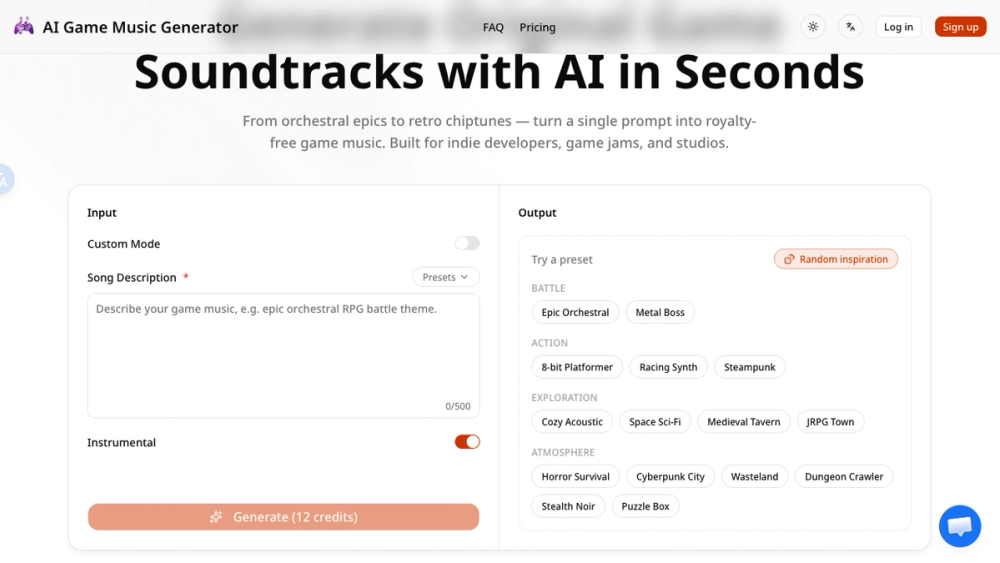
- A guided prompt builder and presets for users who do not have music theory knowledge.
- Game-focused style coverage, including epic orchestral, retro chiptune, ambient, horror, cyberpunk, cozy village, racing, and action examples.
- Public sample tracks that let visitors hear examples such as Epic RPG Battle, Horror Chase, Pixel Platformer, Cyberpunk Neon City, Peaceful Village, and Racing/Action.
- Seamless looping background music support for repeatable gameplay, menus, and level environments.
- Customization signals for mood, genre, style, tempo, instruments, duration, and lyrics.
- Credit-based usage with free and paid plans.
- FAQ coverage for licensing, exports, Unity, Unreal, Godot, refunds, and commercial use.
Use Cases
AI Game Music is useful for early game prototyping. A developer can test whether a scene feels more like a tense horror chase, a peaceful village, a retro platformer, or an epic RPG battle before committing to a final soundtrack direction. That can help teams align visual design, pacing, and mood earlier in production.
The tool is also a strong fit for game jams. Short timelines make it difficult to commission or compose custom music, and the site specifically presents the product as built for indie developers, game jams, and studios. A prompt-based soundtrack workflow can give a small team usable music while they focus on gameplay and polish.
Another use case is content and marketing support. Developers preparing trailers, demo videos, pitch builds, streams, or store-page materials may need quick music variations. AI Game Music can help generate options, though teams should verify that the license and export quality match the intended public use.
Pricing
AI Game Music uses credits. The visible AI Game Music pricing evidence includes a free plan at $0 with 60 credits on signup, described as 5 AI music tracks. It includes access to AI music generation models and guided prompt builder presets, but the fetched evidence also says free-plan songs cannot be kept private and are owned by AI Game Music.
Paid plans shown in the evidence include Starter at $9.90 per month with 360 credits for about 30 AI music tracks per month, Pro at $19.90 per month with 900 credits for about 75 tracks per month plus priority processing and priority support, and Max at $39.90 per month with 2,400 credits. The pricing page also references yearly billing with savings. Users should confirm the current credit cost per generation, whether credits expire, ownership terms, privacy options, and refund policy before subscribing.
User Experience and Support
The AI Game Music site is organized around a direct creation flow: describe the sound, generate, and listen. The presence of presets and a guided prompt builder is helpful for users who know the game scene they want but do not know how to express that as music theory. Sample tracks also make the product easier to evaluate because audio quality needs to be heard, not just described.
Support information is visible through FAQ and plan details. The FAQ says users can contact the team and usually receive a response within one business day, while the Pro plan mentions priority support. The site also surfaces legal and policy links, including Cookie Policy, Privacy Policy, Terms of Service, and Refund Policy, which are important for anyone planning commercial use.
Technical Details
AI Game Music appears to use AI music generation models behind a credit-based interface. Users enter prompts or lyrics and can shape outputs by genre, mood, style, tempo, instruments, duration, and other musical direction. The FAQ topics also mention audio formats and quality, seamless looping, custom lyrics, commercial games, monetized streams, Unity, Unreal, and Godot.
The fetched evidence does not show exact file formats, sample rates, stem support, plugin availability, or direct engine integrations. Developers should verify whether Unity, Unreal, and Godot support means direct integration or simply exported audio that can be imported into those engines. They should also test loop points, volume consistency, and mood fit inside the actual game.
Pros and Cons
Pros
- Clear focus on game soundtracks instead of generic AI music.
- Useful for indie developers, game jams, prototypes, trailers, and background loops.
- Broad visible style range across common game moods and genres.
- Guided prompting lowers the barrier for non-musicians.
- Pricing and credit quantities are visible on the public site.
- FAQ, support, legal, refund, and commercial-use topics are surfaced for evaluation.
Cons
- Free-plan ownership and privacy limits require careful reading.
- Credit usage may add up if a project needs many revisions or variations.
- Exact export formats and engine workflow details are not fully visible in the fetched evidence.
- AI-generated music may still need editing or human curation to match a specific scene perfectly.
- Commercial teams should verify license terms before using tracks in released products.
FAQ
What is AI Game Music used for?
AI Game Music is used to generate original game soundtracks with AI. Users can describe a scene, mood, genre, or atmosphere and create music for prototypes, levels, menus, trailers, or game jam builds.
Who is AI Game Music best for?
It is best for indie developers, small studios, game jam teams, and creators who need music quickly. It is especially useful when a team can describe the feeling of a scene but does not have a composer available.
What styles can AI Game Music generate?
The public site references orchestral, chiptune, ambient, horror, cyberpunk, cozy village, racing, action, and other game-oriented styles. Sample tracks are available for several of those moods.
Does AI Game Music require music theory knowledge?
No. The site says no music theory is required and provides a guided prompt builder and presets to help users describe what they need.
Can AI Game Music generate seamless loops?
Yes. Seamless looping background music is included in the FAQ topics, making the tool relevant for repeated gameplay environments and menu music.
How does the credit system work?
The product uses credits for music generation. The free plan includes 60 signup credits, while paid plans provide larger monthly credit allowances. Users should verify exactly how many credits each generation costs and whether unused credits expire.
Can generated tracks be used in commercial games?
The site describes the music as royalty-free and includes FAQ topics about commercial games and monetized streams. Users should still verify the current license and plan-specific ownership rules before shipping a commercial title.
What should developers test before using it in production?
Developers should test export format, loop quality, audio quality, credit cost, licensing, privacy settings, and fit inside the actual game engine. These checks matter because a track that sounds good alone may need adjustment in gameplay.
Conclusion
AI Game Music is a practical AI soundtrack tool for teams that need game music quickly and do not want to start with a blank composition process. Its public evidence supports a clear product profile: prompt-based generation, game-specific genres, looping support, visible pricing, and relevant FAQ coverage. It is most useful for prototypes, jams, indie games, and creative exploration, with licensing and technical details worth confirming before release.