
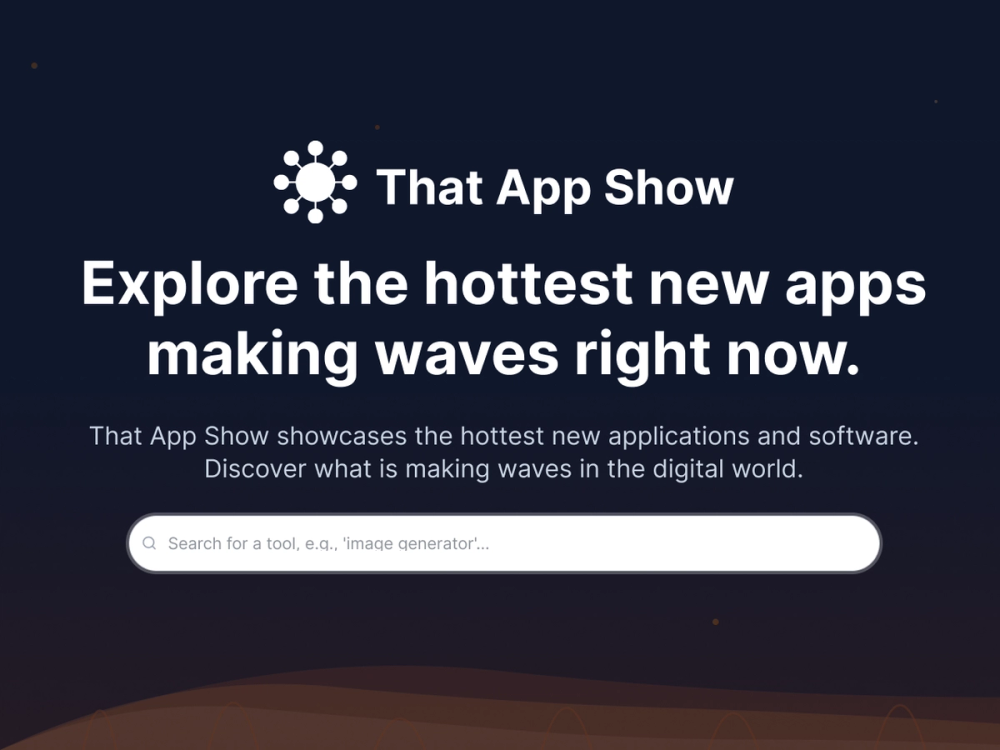
That App Show
Introduction
That App Show is a software discovery directory focused on new apps, SaaS products, and digital tools worth tracking more closely. Based on the public site, it presents itself as a curated showcase rather than a plain database, giving visitors a more editorial way to browse products across business, marketing, design, development, and productivity categories.
The platform appears built for people who want lightweight discovery with enough structure to make comparison practical. Its visible product pages and category context suggest a directory experience aimed at helping users find relevant tools, scan positioning quickly, and decide which products deserve a deeper look.
Key Features
- A curated software directory covering new apps, SaaS tools, and digital products across many categories.
- Featured product sections that give individual tools more visibility than a simple list format.
- Category-based browsing across areas such as AI assistants, analytics, design tools, dev tools, SEO, social media, writing, and more.
- Product summaries that provide quick context about what each listed tool does.
- Search, explore, latest, and submission flows visible in the main navigation.
- Practical comparison framing, with the site explicitly describing the experience as structured around category, pricing, and use case evaluation.
- A public submission flow for founders or teams who want to propose their own product for review.
Use Cases
That App Show is useful for software discovery when someone wants more context than a minimal launch feed or flat product list can offer. A founder, marketer, operator, or curious buyer can browse categories, review short descriptions, and identify tools that are relevant to a specific workflow without starting from generic search results.
It also works well for comparative exploration. The site repeatedly frames itself as a place where users can narrow products by category and pricing context, then compare listings that solve similar problems. That makes it helpful for early-stage evaluation when someone is building a shortlist rather than making a final enterprise buying decision.
For product makers, the submission feature is another practical use case. Teams launching a new app can use the platform as an additional discovery channel, especially if they want exposure inside a directory that presents products with a bit more editorial personality than a standard catalog page.
Pricing
The directory itself appears to be free to browse. The captured FAQ-style content says users can explore listings, compare products, and use the directory without paying, while individual products listed on the platform may have their own separate pricing models.
At the same time, the public evidence does not clearly show whether there are paid submission options, sponsored placements, premium listing upgrades, or monetization features for makers. So while browsing appears free, the full platform business model is not completely visible from the captured page content alone.
User Experience and Support
The strongest visible UX signal is structure. That App Show combines a showcase-style presentation with navigation for latest products, exploration, search, account access, and submission. This helps the directory feel more browsable than a raw software index while still keeping enough order for side-by-side evaluation.
The site also appears to give each listing enough room for a practical one-paragraph understanding of the product, which is useful for quick scanning. However, support details for the directory itself are not strongly documented in the captured evidence. Terms and privacy pages are visible, but there is no clearly exposed help center, onboarding guide, moderation policy detail, or response-time information in the material provided here.
Technical Details
From a technical and product-structure perspective, That App Show is best understood as a browser-based directory with category taxonomy, searchable discovery, and public product submission. The visible navigation and listing layout imply a standard web application designed for ongoing updates rather than a static collection of pages.
Beyond that, technical transparency is limited. The captured evidence does not clearly expose the stack, API support, submission schema, review workflow tooling, or analytics model behind the directory. What is visible is enough to understand the user-facing function of the platform, but not enough to document its underlying implementation with confidence.
Pros and Cons
Pros
- Clear focus on app and SaaS discovery rather than general web listings.
- Broad category coverage helps users browse across many software use cases.
- Showcase-style presentation gives products more personality than a plain directory grid.
- Submission flow makes the platform potentially useful for founders seeking visibility.
- Free browsing lowers the barrier for users who want to explore and compare tools.
Cons
- Support and help resources for directory users are not clearly exposed in the captured content.
- The platform's monetization or listing model for submitters is not fully visible.
- Technical details about review process, update cadence, and data standards are limited.
- Product summaries are useful for discovery, but they may not be enough for deeper software evaluation on their own.
- Some operational claims, such as how often listings are updated, appear in descriptive content but are not independently verifiable from the captured evidence alone.
Conclusion
That App Show looks like a practical software discovery directory for users who want curated browsing with more structure than a simple launch feed. Its main strengths are broad category coverage, product-focused presentation, and a discovery flow that supports quick comparison.
For readers exploring new tools or founders looking for another listing channel, it appears useful and easy to approach. The main open questions are around support depth, submission economics, and platform operations, which would be worth checking directly on the live site if those details matter to the decision.