
Introduction
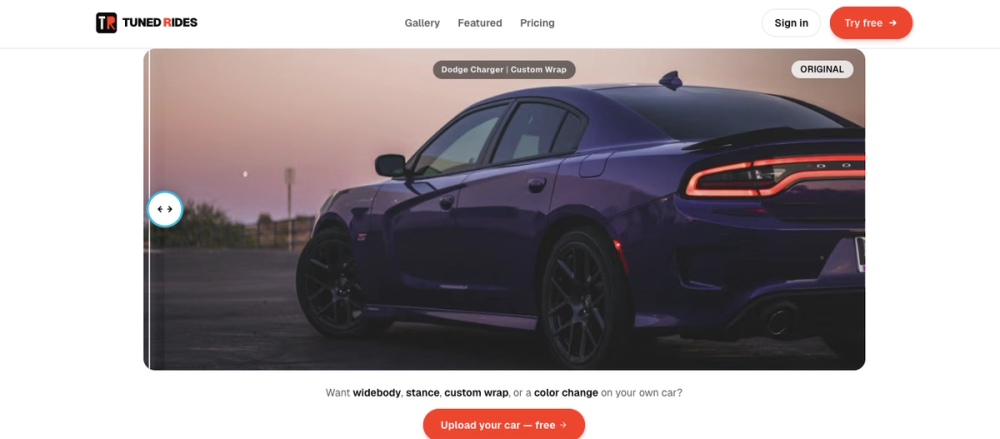
TunedRides is an AI-powered car visualization tool that lets you render photorealistic images of your own car with widebody kits, stance setups, JDM builds, custom wraps, or color changes - all from a single photo upload. The core promise is straightforward: upload a picture of your car, pick a modification style, and get a realistic render in 30 seconds. No account required for the first try.
For car enthusiasts who spend hours scrolling forums or asking "will this look good on my car?", TunedRides addresses the gap between imagination and visual confirmation. The platform renders your actual car - not a generic 3D model - with the modification applied, giving you a realistic preview before committing to expensive parts or shop appointments.
Key Features
AI Photo-Based Rendering
Unlike 3DTuning or similar tools that use generic 3D models, TunedRides works from your actual car photo. The AI identifies your car's body lines, color, and proportions, then applies the modification to produce a photorealistic result. This is the core differentiator: you see YOUR car, not a placeholder.
Eight Modification Styles
The platform supports widebody kits (Liberty Walk, Rocket Bunny, Pandem, RWB), stance and fitment, slammed setups, JDM builds, drift builds, custom wraps, color changes, and offroad modifications. Each style is applied with attention to culture-correct details - the JDM builds reference specific tuner brands, not generic body kits.
200+ Car Model Library
Beyond uploading your own photo, you can select from a library of 200+ stock car models covering BMW, Toyota, Nissan, Honda, Ford, Porsche, Dodge, Subaru, and more. This is useful for planning a build on a car you don't own yet or exploring options on a future purchase.
Real-World Cost Context
Each modification style includes estimated real-world build costs (e.g., widebody: $4K-$12K, wrap: $2K-$6K, JDM: $3K-$30K). This contextualizes the render as a planning tool rather than just a visual toy.
Free Tier with Watermarks
The first render is free with no sign-up. A free account unlocks 2 more renders across all styles. Free renders include a watermark. Pro ($14/month or $99/year) gives 250 HD renders per month with no watermark.
Comparison Tool
The site includes a comparison table showing how TunedRides stacks up against Photoshop, 3DTuning, and forum-based approaches. The key metrics are speed (30 seconds vs hours/days), cost (free vs $50-$200), and whether it uses your actual car photo.
Community Gallery
A public gallery showcases renders submitted by users, organized by modification style. This provides social proof and gives you a sense of what the AI produces on different car types.
Guides and Tutorials
The site publishes educational content on car wraps, PPF vs vinyl, chrome delete, and other modification topics. These articles serve both as SEO content and as genuinely useful planning resources.
Use Cases
Planning a Build Before Spending Money
The primary use case. Before committing $6K-$30K on a widebody kit, wrap, or suspension setup, render it on your actual car to confirm the direction. The site quotes a user who rendered three different drop levels in 10 minutes before choosing his air suspension setup.
Wrap Shops Showing Clients Previews
Professional wrap shops use TunedRides to show clients a realistic preview of a proposed wrap on their actual car before committing to a $2K-$6K install. The site quotes a Miami wrap shop owner who says it "closes 30% more jobs."
Content Creation and Social Media
Car enthusiasts and influencers generate modification imagery without a photoshoot. The renders are realistic enough for social media content, forum posts, and community discussions.
Dealership Sales Support
Dealerships can show buyers what a car looks like in aftermarket configurations while they're still in the showroom, helping close sales on customization packages.
Custom Builder Client Pitches
Builders can walk into client meetings with a render of the client's car in the proposed build, replacing verbal descriptions with visual confirmation.
Pricing
TunedRides uses a freemium model. The free tier includes 3 renders (1 instant + 2 with account) across all 8 styles, with watermarked output and no credit card required. The Pro plan costs $14/month or $99/year (5 months free on annual) and includes 250 HD renders per month, HD 4K upscaling, a walkaround video feature (coming soon), and reference-image style mixing.
The pricing is transparent and the free tier is genuinely useful - not a stripped-down demo. The Pro plan targets wrap shops, content creators, and serious enthusiasts who need volume.
User Experience and Support
The workflow is three steps: upload a photo, pick a style, download the render. The interface is clean and focused on this core flow. The site emphasizes speed (30 seconds per render) and accessibility (no account needed to start).
The comparison table and FAQ section address common questions directly. The "Why not Photoshop?" comparison is particularly useful for users evaluating alternatives.
Support is not prominently detailed beyond the FAQ. The site is built by a community of car enthusiasts, and the tone throughout is conversational and enthusiast-focused rather than corporate.
Technical Details
TunedRides uses AI rendering (referenced as FLUX Kontext in one example) to transform car photos with modification overlays. The system works with JPG, PNG, and HEIC files up to 10MB. The site states it can render any car make and model, identifying body lines automatically.
The renders are described as "design intent renders, like an architect's rendering, not engineering blueprints" - meaning they show how the modification will look, not exact panel dimensions. This distinction is important for users who might expect engineering-level accuracy.
All processing appears to happen server-side, with results delivered in 30 seconds. The site does not disclose specific infrastructure details.
Pros and Cons
Pros:
- Uses your actual car photo, not generic 3D models
- Photorealistic output in 30 seconds
- Free tier with no credit card required
- Eight modification styles covering popular build types
- Real-world cost context for each modification
- 200+ stock car models available
- Professional use case validated by wrap shop testimonials
- Comparison tool against Photoshop and 3DTuning
Cons:
- Free renders include watermarks
- 250 renders/month on Pro may not be enough for high-volume shops
- Renders are design intent, not engineering blueprints
- No mobile app mentioned
- Walkaround video feature is still in development
- Limited to still images - no interactive 3D viewing
- Accuracy depends on photo quality and angle
FAQ
How is TunedRides different from 3DTuning?
3DTuning uses generic 3D models of your car type. You're modifying a model that looks roughly like your car. TunedRides uses your actual car photo and transforms it with AI, so the output shows YOUR specific car with YOUR color and YOUR existing mods. The result looks like a real photograph, not a 3D game asset.
What kind of photo should I upload?
A three-quarter front angle (45 degrees from the front-left or front-right corner) produces the best results for most modifications. Side-on works well for stance renders. Any modern smartphone photo is sufficient.
How free is the free tier?
Your first render is free with no sign-up and no credit card. Creating a free account unlocks 2 more free renders across all 8 modification styles. Free renders include a watermark. Pro ($14/month or $99/year) unlocks 250 HD renders per month with no watermark.
Can wrap shops use TunedRides professionally?
Yes. Wrap shops use TunedRides to show clients a realistic preview of a proposed wrap on their actual car before committing to a $2K-$6K install. Pro accounts get 250 renders per month for business use.
Does TunedRides work on any car?
Yes. Upload a photo of any car make and model, or choose from 200+ stock models. The AI identifies body lines and proportions and applies modifications accurately regardless of make or model.
How accurate are the renders?
The renders show modification proportions and visual impact accurately. They're design intent renders, not engineering blueprints. Use them to confirm direction and communicate with your shop, not for exact panel measurements.
Conclusion
TunedRides solves a real problem for car enthusiasts: visualizing expensive modifications before committing to them. The combination of photo-based AI rendering, genuine free-tier utility, and real-world cost context makes it a practical planning tool rather than just a visual toy. The professional use case - wrap shops showing clients previews - validates that the renders are realistic enough for business use. At $14/month for 250 HD renders, the pricing is accessible for both individuals and small shops. If you're planning a build and want to see it on your actual car before spending thousands, TunedRides is worth trying with a free render.