
Introduction
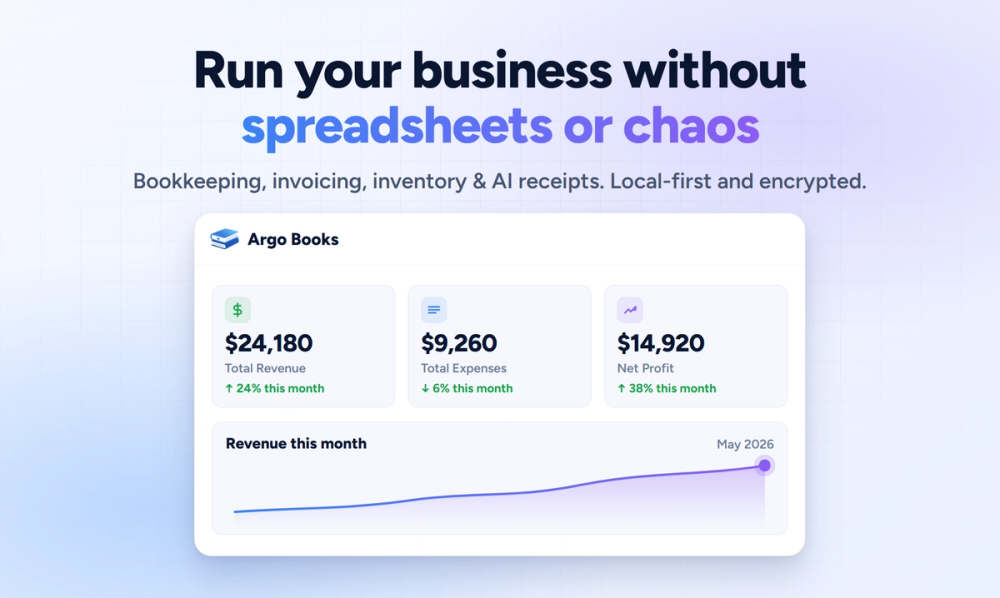
Argo Books is desktop business management software aimed at small business owners who want bookkeeping, invoicing, inventory, and receipt handling in one system without living in spreadsheets. The public site emphasizes AI receipt scanning, spreadsheet import, predictive analytics, and local-first storage with encryption. Readers should treat accuracy percentages and growth claims on marketing pages as on-site statements to validate in a trial, not independently audited metrics.
Key Features
- AI receipt scanning - The site describes snapping or uploading receipts so the product extracts supplier, date, line items, tax, and totals, with review before saving.
- Invoicing and payments - Marketing copy covers customizable invoices, payment tracking, and Premium-tier online payment links via Stripe, PayPal, and Square.
- Expense and revenue tracking - Guided forms, categorization, and validation are presented as core financial workflows.
- Inventory and rental management - Stock levels, low-stock alerts, and rental booking-style management appear as operational modules.
- Spreadsheet import - Excel or CSV drops with automatic column mapping and type detection are highlighted as a time-saver.
- Predictive analytics - Premium messaging includes revenue forecasting, seasonal patterns, and dashboard-style reporting.
- Multi-company support - FAQ-style copy on the site states unlimited companies even on the free plan, with separate records per business.
Use Cases
Owner-operators who still type receipts into spreadsheets may use Argo Books to digitize paper expenses and attach images to transactions for year-end reporting. The site's tax-ready and report-generation language targets users who want categorized books without hiring a full-time bookkeeper first.
Retail or product businesses can lean on inventory features for stock tracking and alerts, while rental-oriented businesses are addressed with booking and availability messaging. Teams that invoice regularly may hit free-tier invoice caps and consider Premium for unlimited sends and payment links-limits described on the pricing pages should be confirmed on the live site.
Privacy-conscious users are a fit if the "data stays local" and offline desktop positioning matches their policy; verify deployment details and backup practices before migrating sensitive financial history.
Pricing
The site advertises a free download with core features and a Premium plan at $15 CAD/month (with annual pricing mentioned as $150 CAD/year in FAQ-style copy). Free-tier bullets in the marketing material reference caps such as 25 invoices per month and limited monthly AI receipt scans and spreadsheet imports, while Premium advertises higher AI limits (for example 500 receipt scans per month), predictive analytics, biometric login via Windows Hello, and priority support. Exact current limits and currencies should be confirmed on the pricing page before purchase.
User Experience and Support
Argo Books presents a guided, non-accountant-friendly interface with dashboards for revenue, expenses, and profit. Support routes include email support, feedback submission, community, and documentation links on the public site. Premium subscribers are described as receiving priority support.
The product is framed as a desktop app that can work offline with local data storage, which changes onboarding compared with cloud-only accounting tools-confirm platform availability (for example Windows Hello references) on official download pages.
Technical Details
Marketing pages cite AES-256-GCM encryption for stored records and describe OCR combined with LLM-style interpretation for receipts. Integrations mentioned for payments include Stripe, PayPal, and Square on Premium invoicing flows. The site does not present a public API catalog in the extracted evidence; integration depth should be confirmed with documentation or support.
Biometric login is tied to Windows Hello in Premium copy, which implies a Windows desktop focus for that feature.
Pros and Cons
Pros
- Broad feature set spanning receipts, books, invoices, inventory, and rentals in one product narrative.
- Free tier with substantial core functionality may lower risk for very small businesses testing the workflow.
- Local/offline positioning and encryption messaging may appeal to owners wary of cloud-only finance tools.
- Spreadsheet import and AI scanning address common onboarding pain from legacy Excel workflows.
Cons
- AI scan and import quotas on free vs Premium tiers require careful reading to avoid surprise limits.
- Accuracy claims (for example 99.9% on printed receipts) are marketing statements; messy real-world receipts may still need edits.
- Windows Hello and desktop assumptions may not fit every team's device mix.
- Payment processor availability and fees depend on third-party services named on the site-verify terms separately.
FAQ
What is Argo Books and who is it for?
Argo Books is described as modern bookkeeping and business management software for small business owners, combining invoicing, expenses, inventory, receipts, and reporting. It appears aimed at operators who want structured books without enterprise accounting complexity.
How does the free plan compare to Premium?
Public FAQ-style copy states the free plan includes core features with monthly caps on invoices and AI usage, while Premium removes invoice limits, raises AI scan allowances, adds predictive analytics, Windows Hello login, and priority support. Confirm current numbers on the live pricing page.
Does Argo Books store data in the cloud?
The site emphasizes a desktop app with local data and offline use, stating financial data does not leave the computer in that positioning. Buyers with compliance needs should confirm backup, multi-device, and recovery behavior directly.
Can Argo Books handle multiple businesses?
Marketing FAQ text claims unlimited companies on the free plan with separate transactions and reports per business. Verify whether this matches your license and how backups work per company file.
What integrations are visible for getting paid?
Premium invoicing copy references online payment links via Stripe, PayPal, and Square. Setup steps, fees, and supported countries are not fully detailed in the extracted pages.
What should users verify before relying on AI receipt scanning?
Test your typical receipt types (thermal, faded, handwritten), review extraction before saving, and confirm monthly scan limits on your plan. Treat marketing accuracy percentages as aspirational until validated on your documents.
Conclusion
Argo Books markets a consolidated small-business back office with AI-assisted capture, local desktop storage, and tiered Premium upgrades for heavier invoicing and analytics. Prospective users should download the free edition, validate receipt and import limits against their volume, and read pricing and documentation on the official site before switching from existing tools.