
Introduction
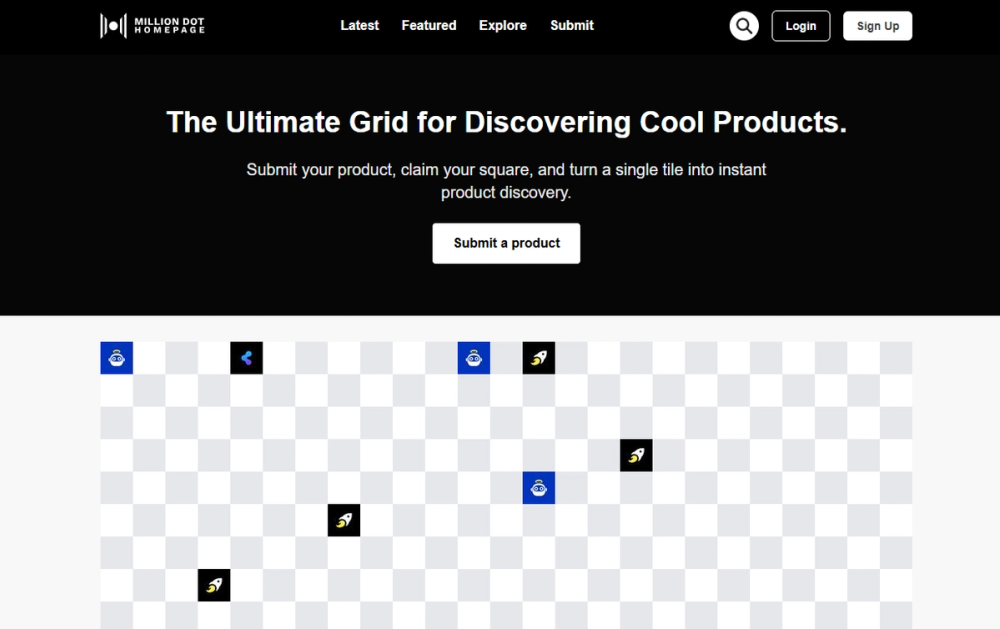
Million Dot Homepage presents itself as a visual grid for discovering new products and tools. Its central idea is simple: makers can submit a product, claim a square, and turn that tile into a discovery point for visitors browsing the grid.
The site is most relevant for two audiences: people who like scanning new tools visually, and builders who want a lightweight product-placement surface. The public page makes the visual discovery concept clear, but it leaves pricing and some submission details less visible, so makers should verify the full terms before relying on it for promotion.
Key Features
- Visual product grid: The homepage describes Million Dot Homepage as "The Visual Grid for Discovering New Products & Tools."
- Product submission concept: The site's meta description says makers can submit a product, claim a square, and use a tile for product discovery.
- Featured product area: The public page includes a Featured products section with examples such as Eurisko Digital Banking Platform, Sprite-AI, Insta Posts, LoadTester, GPT Image 2 Studio, GPT-Image2, TIDY - AI Property Manager, and Microplastic Intake App.
- Explore and discovery navigation: Visible navigation includes Latest, Featured, Explore, Submit, Search, Login, and Sign Up.
- Category coverage: The page lists categories such as AI Assistants, Analytics & Data, Audio & Music, Blockchain & Crypto, Blogging & Publishing, Boilerplates & Templates, Business & Finance, Business Intelligence, Career & Jobs, Chrome Extensions, Content Creation, Customer Support, and Design Tools.
- Sponsor area: The homepage shows a Sponsors section, which suggests the site supports promotional placement, though the exact sponsorship terms are not fully visible in the fetched page.
Use Cases
Million Dot Homepage appears useful for product discovery when a visitor wants a more visual browsing experience than a standard text list. The grid format can help users quickly scan product names, short descriptions, and categories, especially when they are looking for new AI tools, design resources, developer products, marketing products, or other software launches.
For makers, the clearest visible use case is placing a product into a visual discovery grid. The public page explicitly uses submission language, so it is fair to treat Million Dot Homepage as a product-placement destination. Still, a practical founder should confirm how squares are assigned, whether placement is permanent or time-limited, and what review or approval process applies.
The site also appears to support sponsored visibility, given the Sponsors heading and visible ad copy. That may be useful for teams comparing low-friction promotional surfaces, but the page does not provide enough public detail to evaluate expected reach, audience quality, or campaign reporting.
Pricing
Pricing is not clearly visible in the fetched homepage evidence. The page shows Submit, Login, Sign Up, and Sponsors signals, but it does not expose plan names, one-time pricing, recurring pricing, refund terms, or sponsorship costs in the available content. Before submitting a product or claiming a square, makers should check the current submission flow and terms so they understand whether placement is free, paid, reviewed, sponsored, or subject to category restrictions.
User Experience and Support
The public page is built around direct navigation: Latest, Featured, Explore, Submit, Search, Login, and Sign Up. That structure suggests a simple directory-style browsing experience where visitors can move between recent products, featured products, search, and broader category exploration without a complex interface.
Support information is limited in the visible evidence. "Customer Support" appears as a category label, not necessarily as a support channel for Million Dot Homepage itself. The page shows Terms & Conditions and Privacy Policy links, but it does not clearly show a help center, documentation page, contact method, or support response expectations.
Technical Details
Million Dot Homepage is a web-based product discovery page centered on a visual grid and product tiles. The available page evidence shows product cards with short descriptions, navigation for Latest and Featured views, category labels, search, login, and sign-up routes.
The listed categories include technical and software-related areas such as Analytics & Data, Chrome Extensions, Business Intelligence, AI Assistants, and Design Tools. These should be read as product categories on the site, not as integrations provided by Million Dot Homepage. The fetched evidence does not confirm APIs, analytics dashboards, automated submission tools, or third-party integrations for site users.
Pros and Cons
Pros
- The visual grid concept gives the site a distinct browsing format for product discovery.
- The homepage clearly explains the core submission idea: submit a product, claim a square, and use a tile for discovery.
- Featured products and categories make the page more informative than a blank submission form.
- Navigation labels such as Latest, Featured, Explore, Submit, and Search make the main user paths easy to understand.
- The category list suggests room for a wide range of software, AI, business, content, and design products.
Cons
- Pricing and sponsorship details are not clearly visible in the fetched public evidence.
- The page does not explain how product squares are approved, ranked, rotated, or maintained.
- Public support information is limited, beyond Terms & Conditions and Privacy Policy links.
- The site does not visibly provide performance data, visitor metrics, or reporting details for submitted products.
- Makers should not assume a listing will generate traffic or leads without verifying the audience and placement terms.
FAQ
What is Million Dot Homepage?
Million Dot Homepage is a visual grid for discovering new products and tools. The homepage says makers can submit a product, claim a square, and turn that tile into a product discovery point.
Who is a good fit for Million Dot Homepage?
It appears suited to visitors who like browsing new products visually and to makers who want a simple product-placement surface. It may fit software founders, AI tool creators, design product makers, and other builders whose products match the categories shown on the site.
What kinds of products appear on Million Dot Homepage?
The visible featured examples include products related to AI digital banking, pixel sprite creation, carousel generation, HTTP/API load testing, property management, microplastic intake assessment, telehealth software, marketing data insights, and calorie estimation. The category list also includes areas such as AI Assistants, Analytics & Data, Chrome Extensions, Content Creation, Customer Support, and Design Tools.
How does the "claim your square" idea work?
The public page says users can submit a product, claim a square, and turn a tile into instant product discovery. It does not fully explain the assignment, approval, payment, duration, or maintenance rules for those squares, so makers should review the submission process before committing.
Does Million Dot Homepage show pricing publicly?
The fetched homepage evidence does not show clear pricing or plan details. It shows Submit, Login, Sign Up, and Sponsors signals, but not specific costs. Users should confirm whether product placement, sponsorship, or square claiming is free, paid, or subject to approval.
Does Million Dot Homepage offer support or documentation?
The visible page includes Terms & Conditions and Privacy Policy links, but it does not clearly show a help center, documentation section, or direct support channel. "Customer Support" appears in the category list, so it should not be read as a support promise from the platform itself.
Can users search or browse by category?
Yes, the visible navigation includes Search and Explore, and the page lists multiple categories. This suggests users can browse products beyond the featured area, although the fetched page does not show every detail of the filtering experience.
What should makers verify before submitting a product?
Makers should verify pricing, square ownership rules, review criteria, placement duration, sponsorship terms, category fit, and whether any reporting or traffic data is available. These details matter because the homepage explains the concept, but it does not provide enough information to evaluate promotional outcomes.
Conclusion
Million Dot Homepage has a clear product-discovery hook: a visual grid where submitted products can occupy memorable tiles. That format may appeal to users who prefer visual scanning and to makers looking for a simple way to present a new tool.
The site's concept is easy to understand from the homepage, but pricing, support, review rules, and placement mechanics need closer verification. It is worth exploring as a discovery surface, provided makers treat it as one visibility option rather than a guaranteed acquisition channel.