
Introduction
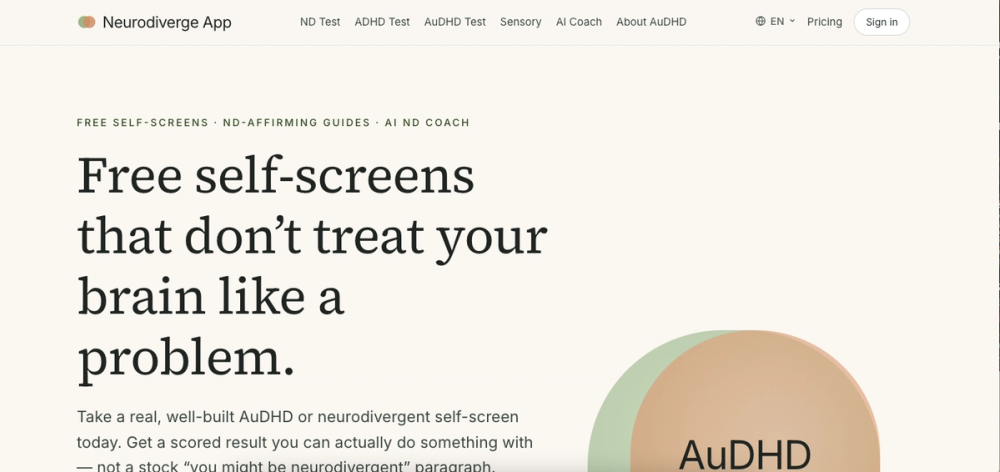
Neurodiverge App is a self-screening platform designed for adults exploring whether they might be autistic, ADHD, or AuDHD - the lived experience of being both autistic and ADHD. Rather than offering a single-page quiz that ends with a vague paragraph, the app provides scored self-screens built from validated instruments, translated into plain language, and grounded in the accounts of people who actually live with neurodivergence.
The public site positions itself as identity-first and neuroaffirming. It explicitly avoids framing autistic or ADHD traits as symptoms of a disorder and states it will not recommend Applied Behavior Analysis or link to clinicians or content that does. For anyone who has arrived here after months of wondering why standard anxiety or depression framing never quite fit, that positioning matters.
Key Features
Multiple Specialized Self-Screens
The app offers four distinct self-screens, each targeting a different area of inquiry. The Neurodivergent Test covers 30 questions across six dimensions - autism, ADHD, dyspraxia, dyslexia, sensory processing, and tics - and produces a scored profile across all six. The AuDHD Test focuses on the overlap between autism and ADHD with 20 questions covering hyperfocus, masking, sensory load, and executive load. The Adult ADHD Test uses 20 ASRS-informed questions across four dimensions with a subtype lean and per-dimension breakdown. The Sensory Profile Test spans all 8 sensory channels - hearing, sight, touch, smell, taste, balance, body, and interior - and produces a radar-chart result with per-channel accommodations.
Scored Results, Not Stock Paragraphs
Each screen produces a scored result rather than a generic "you might be neurodivergent" conclusion. The result pages are designed to give you something actionable: dimension-level breakdowns, subtype leans, and accommodation suggestions. The site describes this as "the kind of result page we wish someone had given us."
Validated Instrument Foundation
Where validated instruments exist, the screens are built from them and then translated into plain English. This is a meaningful distinction from the many informal online quizzes that use invented questions without grounding in established assessment frameworks.
Five Recognition Moments Context
The site includes an educational section describing the five most common adult neurodivergent recognition moments: a child's diagnosis, reading another adult's account, burnout cracking the mask, hormonal shifts (particularly perimenopause), and therapy surfacing the pattern. This context helps normalize the experience of late discovery and frames it within a broader community understanding.
AI ND Coach
The platform mentions an AI ND coach as part of its feature set alongside the self-screens and ND-affirming guides. The evidence does not elaborate on the coach's capabilities or limitations, so readers should evaluate its guidance with the same care they would apply to any AI-based health or wellness tool.
Quick, Low-Friction Start
Each screen takes between 4 and 6 minutes, requires no signup to start, and allows skipping any question. The low barrier to entry is intentional: the site wants you to get a result without creating an account or committing to a process.
Use Cases
Adult Self-Discovery
The primary use case. Adults who suspect they might be autistic, ADHD, or both can take a structured self-screen to explore that question. The scored results provide a starting point for reflection, not a clinical diagnosis.
Pre-Consultation Preparation
Before seeking a formal assessment, some people use self-screens to clarify which dimensions feel most relevant. The per-dimension breakdowns in the Neurodivergent and AuDHD tests can help someone articulate what they want to discuss with a clinician.
Sensory Profile Understanding
The Sensory Profile Test is useful for anyone - not just those exploring neurodivergence - who wants to understand their sensory patterns across all eight channels. The radar-chart output and per-channel accommodations can inform practical changes in workspaces, daily routines, or self-care.
Supporting a Loved One
Parents, partners, or friends of recently diagnosed individuals can use the screens to better understand the experience. The five recognition moments section is particularly relevant for parents who recognize their own traits after their child's diagnosis.
Community and Self-Advocacy
For people already navigating neurodivergence, the neuroaffirming framing and identity-first language provide a community-aligned resource that can support self-advocacy conversations with employers, educators, or healthcare providers.
Pricing
The public site references a pricing page but does not display specific pricing details on the main page. The self-screens appear to be freely accessible - no signup or payment is required to start a screen - suggesting a freemium model where basic screening is free and additional features like the AI ND coach or advanced guides may require payment.
The explicit statement "no signup to start" and "no diagnosis, no medical advice" positions the free tier as genuinely functional rather than a demo.
User Experience and Support
The interface is straightforward: pick the screen that matches your question, answer the questions, and get a result. The site is clearly organized around four main self-screens with a clean call-to-action flow. The estimated completion times (4-6 minutes per screen) are prominently displayed, which helps set expectations.
The neuroaffirming tone is consistent throughout the public pages. The site avoids clinical jargon and frames neurodivergence through lived experience rather than diagnostic language. For users who have had negative experiences with clinical or pathologizing framing, this approach is likely reassuring.
Support channels are not prominently detailed on the main page. A sign-in option and pricing page suggest account-based features exist, but the self-screening flow itself operates without authentication.
Technical Details
The app is available at neurodiverge.app and appears to function as a web-based application. The evidence does not disclose specific frameworks, programming languages, or whether a native mobile app exists alongside the web version.
The Sensory Profile Test's radar-chart output suggests client-side charting or visualization capability. The per-dimension scoring across multiple screens implies a structured scoring engine that can handle different assessment formats and produce consistent result breakdowns.
The site's emphasis on privacy - no diagnosis, no medical advice, no account required to start - suggests that the self-screening flow itself does not collect sensitive health data in a way that requires authentication, though readers should review the privacy policy for confirmation.
Pros and Cons
Pros:
- Multiple specialized screens covering different aspects of neurodivergence
- Built from validated instruments where available, translated into plain language
- Scored results with dimension-level breakdowns, not generic conclusions
- Identity-first, neuroaffirming framing throughout
- Quick completion times (4-6 minutes per screen)
- No signup or payment required to start
- Explicitly avoids pathologizing language and ABA recommendations
- Sensory Profile Test covers all 8 sensory channels with radar-chart output
Cons:
- Self-screens are not clinical diagnoses and should not be treated as such
- AI ND coach capabilities are not well-documented in the evidence reviewed
- Specific pricing for premium features is not visible on the main page
- Support channels are not prominently displayed
- Only the main page was fetched, so deeper features may have limitations not visible here
- No explicit mention of data privacy practices beyond the general positioning
FAQ
Is the Neurodiverge App a clinical diagnostic tool?
No. The site explicitly states "no diagnosis, no medical advice." The self-screens are screening tools designed to help you explore whether neurodivergence might be relevant to your experience. They are not a substitute for professional assessment.
How are the self-screens different from online quizzes?
The screens are built from validated instruments where they exist, translated into plain English, and produce scored results with dimension-level breakdowns. Most online quizzes use invented questions and produce generic conclusions. The Neurodiverge App aims to give you a structured profile rather than a binary yes/no answer.
Do I need to create an account to take a self-screen?
No. The site states "no signup to start" for the self-screens. You can take a screen, get your result, and decide whether to create an account based on whether the additional features are useful to you.
What is AuDHD?
AuDHD refers to the lived experience of being both autistic and ADHD simultaneously. The Neurodiverge App provides a dedicated AuDHD Test that covers the overlap between these two neurotypes - hyperfocus, masking, sensory load, and executive function - rather than treating them as separate categories.
Is the AI ND coach a replacement for therapy?
The evidence does not provide enough detail to make that determination. The site positions the AI ND coach as a feature alongside the self-screens and guides, but readers should evaluate its guidance with the same care they would apply to any AI-based wellness tool and should not treat it as a substitute for professional support.
Can the sensory profile help me even if I am not exploring neurodivergence?
The Sensory Profile Test covers all 8 sensory channels and produces per-channel accommodations. While it is offered in the context of neurodivergent self-discovery, the sensory information itself may be useful for anyone who wants to understand their sensory patterns and adjust their environment accordingly.
Conclusion
Neurodiverge App fills a specific gap in the neurodivergent self-discovery space: structured, scored self-screens that go beyond a single-page quiz without requiring a clinical setting. The identity-first, neuroaffirming approach and the grounding in validated instruments give it more substance than the many informal quizzes that circulate online. For adults who have been wondering whether they might be autistic, ADHD, or both, the combination of quick completion, no-signup access, and dimension-level results makes this a practical starting point. The site is transparent that these are self-screens, not diagnoses, and that framing matters for anyone using the results as a basis for further exploration or clinical conversations.