
Introduction
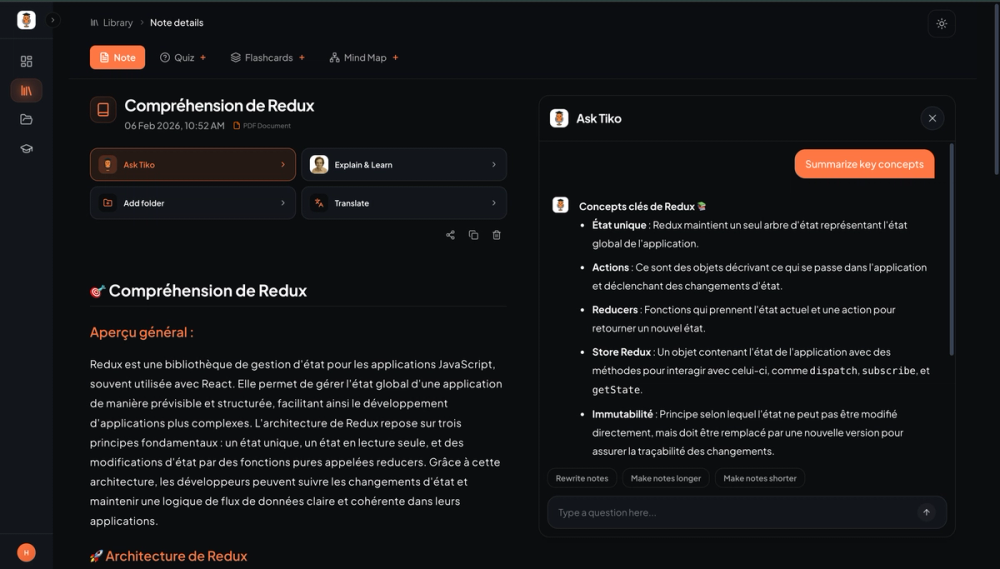
TikoNote is an AI-powered study app that helps students turn lectures, PDFs, videos, YouTube lessons, audio, and notes into flashcards, quizzes, summaries, and mind maps. Its public site positions the app around the Feynman Technique, active recall, spaced repetition, and exam preparation. The strongest fit is for students who want to move from scattered study inputs to more structured review materials, while still checking pricing, privacy terms, and generated output quality before relying on it for a full course.
Key Features
- AI flashcards generated from PDFs, audio, videos, and other study materials for active recall practice.
- Automated quizzes and practice exams designed to help students test knowledge and identify gaps.
- Smart summaries that condense lectures, PDFs, videos, and longer learning resources into key takeaways.
- AI mind maps that turn dense topics into visual structures for students who need to see relationships between ideas.
- Multi-source input support, including PDFs, audio recordings, YouTube links, lectures, videos, and notes.
- Smart folders for organizing materials by subject, semester, project, or study workflow.
Use Cases
TikoNote is useful for students who collect learning material from many places and need a faster way to prepare for review. A lecture recording, chapter PDF, YouTube explanation, or set of notes can be transformed into study aids such as flashcards, summaries, quizzes, and mind maps. That makes the app especially relevant during exam periods, when students need to review repeatedly rather than simply reread material.
The app also fits learners who want to practice active recall. Instead of manually creating every flashcard or quiz question, students can use TikoNote to generate review formats from class content, then edit or verify the results as needed. This can reduce setup time, but it should not replace checking facts, formulas, definitions, or teacher-specific expectations against the original course content.
Visual learners may benefit from the mind map feature. TikoNote describes its mind maps as a way to turn complex or messy notes into clearer diagrams, which can help students understand how concepts connect before memorizing details. For subjects with diagrams, processes, or layered concepts, that visual structure may be more useful than a plain summary alone.
Pricing
TikoNote's public pages mention a web version, an App Store download, login access, and a FAQ question about free use, but the available pages do not show a full pricing table, plan tiers, generation limits, or refund terms. Students should check the TikoNote homepage and the relevant app listing before depending on it for heavy study use. This is especially important for students who plan to upload long lectures, large PDFs, or many course files over a semester.
User Experience and Support
The user experience appears centered on a simple study flow: add learning material, let the AI transform it into structured notes, then review through flashcards, quizzes, summaries, and mind maps. The site also points to both a web version and an App Store download, giving students more than one way to access the product.
Support information is more limited. TikoNote includes FAQ content and a features page that explains the main study tools, but the visible pages do not clearly show a dedicated help center, contact route, support response times, or troubleshooting documentation. Students using the app for high-stakes exam preparation should confirm how support works and how easily they can correct, export, or delete generated study materials.
Technical Details
TikoNote is presented as a multi-modal AI study app rather than a developer tool. The public feature copy mentions PDFs, audio recordings, YouTube links, videos, lectures, and notes as input types, with AI producing notes, flashcards, quizzes, summaries, and mind maps.
The visible pages do not explain the underlying AI model, storage policy, export formats, file-size limits, offline support, integrations, or API access. Those details matter for students who handle private notes, paid course materials, or institution-provided resources. Before uploading sensitive study material, users should review current privacy terms and platform requirements.
Pros and Cons
Pros
- Converts several common study inputs into multiple review formats.
- Supports active recall through flashcards and quiz generation.
- Offers mind maps for students who prefer visual learning.
- Includes smart folders for keeping study material organized.
- Provides both web and App Store access signals on the public site.
Cons
- Pricing, free-plan limits, and subscription details are not clearly shown on the visible pages.
- Support and troubleshooting information is limited.
- Privacy, export, model, and data-retention details are not explained in depth on the product pages.
- AI-generated study outputs still need review against original course content.
- Claims about faster learning and longer retention may vary by learner, subject, and study habits.
FAQ
What is TikoNote?
TikoNote is an AI study app that turns lectures, PDFs, videos, YouTube links, audio, and notes into flashcards, quizzes, summaries, and mind maps. It is designed to help students create review materials from existing learning content.
Who should use TikoNote?
TikoNote is best suited for high-school and university students who work with lecture recordings, readings, online videos, and notes. It may be especially useful for exam preparation, active recall practice, and organizing study materials by subject.
Can TikoNote make flashcards from PDFs and videos?
The public feature copy says TikoNote can generate flashcards from PDFs, audio, and videos, and it also mentions YouTube links as a supported input. Students should test representative course content to see whether the generated cards match their subject and exam style.
Does TikoNote help with quizzes and practice exams?
Yes, TikoNote's site describes AI quiz and practice-exam generation from study material. This can help students test themselves and identify weak areas, although generated answers should still be checked against course notes, textbooks, or instructor guidance.
Is TikoNote free?
The visible pages include a question about whether TikoNote is free to use, but they do not show a complete pricing table or usage limits. Users should verify current free access, paid plans, and generation limits through the official app or website before relying on it heavily.
What should students check before uploading course files?
Students should review privacy terms, supported file types, upload limits, deletion controls, and any rules around copyrighted or institution-owned content. These details are important when using AI tools with private notes, recorded lectures, or paid learning resources.
Does TikoNote replace normal studying?
No. TikoNote can help create summaries, flashcards, quizzes, and mind maps, but students still need to read, solve problems, attend classes, and verify important information. The app is better understood as a study preparation tool than a complete replacement for learning.
Conclusion
TikoNote is a focused AI study app for turning raw learning material into review-ready formats. Its strongest value is the combination of summaries, flashcards, quizzes, mind maps, and folder organization around a student workflow. Before using it for important exams, students should confirm pricing, support, privacy rules, and the accuracy of generated study content for their specific subjects.