
Introduction
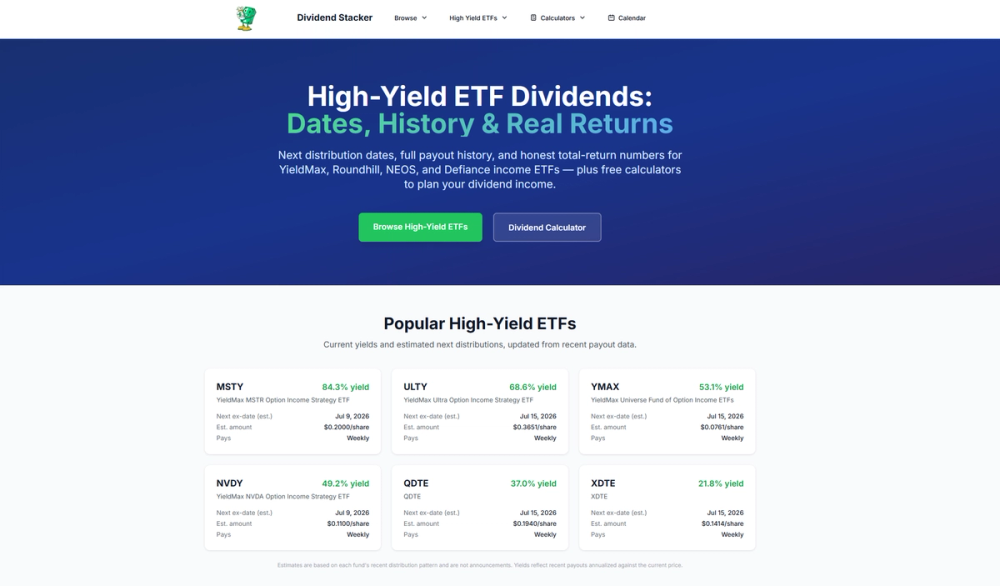
Dividend Stacker is a free educational platform designed for income-focused investors who want clearer visibility into high-yield ETF distributions. The site aggregates data on popular income-focused funds from providers like YieldMax, Roundhill, NEOS, and Defiance, presenting estimated next payout dates, distribution histories, and total-return comparisons alongside practical calculators for planning dividend income.
The public page presents Dividend Stacker as a research companion rather than an investment advisory service, emphasizing that all figures are hypothetical projections based on recent distribution patterns. For investors navigating the increasingly crowded landscape of covered-call and option-income ETFs, the tool appears designed to reduce manual spreadsheet work and provide quick reference points for comparing fund characteristics.
Key Features
- ETF Database with Distribution Estimates: Tracks high-yield income ETFs across multiple fund families including YieldMax, Roundhill, NEOS, Defiance, and REX Shares, displaying current yield estimates and projected next ex-dates based on recent payout patterns
- Total Return Calculator: Projects what a past investment would be worth today with and without dividend reinvestment for any ticker in the database
- Dividend Calculator: Estimates monthly income and compound growth scenarios from any yield percentage, with options for reinvestment and tax considerations
- Fund Comparison Tool: Side-by-side analysis of total return and income metrics across dividend stocks and ETFs, including benchmark comparisons against SPY and QQQ
- Individual Fund Pages: Each tracked ETF has a dedicated page showing estimated next payout, full distribution history, $10,000 total-return comparison, and integrated calculators
- Dividend Calendar: Tracks upcoming distribution dates across the covered fund universe
Use Cases
Dividend Stacker appears most relevant for retail investors building or managing income-focused portfolios who need quick access to distribution timing and yield comparisons. The fund family organization suggests particular utility for investors researching specific provider strategies-such as YieldMax's single-stock option income ETFs or Roundhill's 0DTE covered call products-who want to compare characteristics across a provider's full lineup.
The calculators address practical planning questions that arise when managing dividend portfolios: projecting monthly income from a given yield, understanding reinvestment impact over time, and sizing positions based on distribution schedules. Investors evaluating covered-call ETFs against traditional dividend stocks may find the comparison tool useful for visualizing total-return differences alongside yield metrics.
The site also serves investors who want visibility into payout cadences, particularly for funds advertising weekly distributions. Knowing estimated ex-dates helps with cash flow planning and understanding when purchasing shares would capture upcoming distributions.
Pricing
Dividend Stacker appears to be entirely free to use. The site does not display subscription tiers, premium features, or account requirements in the available evidence. All calculators and fund data are publicly accessible without registration.
User Experience and Support
The interface organizes content around three primary navigation paths: browsing high-yield ETFs by fund family, accessing calculators directly, and viewing a dividend calendar. The fund family structure allows investors to research providers as a group-useful when evaluating which fund family's strategy aligns with their goals.
The calculators are integrated throughout the fund pages, allowing users to run projections without switching contexts. The site includes standard footer links for contact, methodology, privacy policy, terms of use, and a sitemap. An "About" page and methodology documentation suggest some transparency around data sources and calculation approaches, though the specific depth of these pages is not visible in the extracted evidence.
A disclaimer is prominently displayed stating that the site is for educational and informational purposes only, does not provide financial advice or investment recommendations, and that all calculations and yield estimates are hypothetical and not guaranteed.
Technical Details
The available evidence does not specify technical implementation details, API availability, or data source specifics. The site appears to be a web-based tool accessible through standard browsers without requiring downloads, browser extensions, or mobile applications. The extracted content does not mention integrations with brokerage platforms, portfolio tracking services, or data export capabilities.
Pros and Cons
Pros
- Free access to ETF distribution data and planning calculators without registration requirements
- Coverage of multiple high-yield fund families in one interface
- Practical calculators for income projection and total return analysis
- Clear disclaimers about the hypothetical nature of projections
- Fund pages include specific details like estimated ex-dates and payout amounts per share
Cons
- Yield estimates are projections based on recent patterns, not official fund announcements
- Limited to ETFs in the database-does not appear to cover the broader dividend stock universe comprehensively
- No visible API or data export options for users wanting to integrate data into external tools
- The depth of methodology documentation and data refresh frequency is unclear from the public page
FAQ
What is Dividend Stacker and what problem does it solve?
Dividend Stacker is a free educational resource that aggregates distribution data on high-yield income ETFs from providers like YieldMax, Roundhill, NEOS, and Defiance. It addresses the practical challenge of tracking payout dates, estimating yields, and comparing total returns across funds that often have complex distribution patterns and limited historical data.
Who is Dividend Stacker best suited for?
The tool appears designed for income-focused retail investors researching covered-call and option-income ETFs, dividend growth investors evaluating fund options, and portfolio builders who want quick-reference data for distribution timing and yield comparisons without building manual spreadsheets.
What can users clearly verify from the public site?
Users can view estimated next distribution dates and amounts for tracked ETFs, browse funds organized by fund family, access dividend and total return calculators, view distribution histories for individual funds, and compare metrics across multiple ETFs with benchmark references to SPY and QQQ.
What should users verify before relying on Dividend Stacker's data?
Users should confirm current distribution amounts and dates directly with fund providers or brokerage platforms, as the site's estimates are projections based on recent patterns and may not reflect actual announced distributions. Investment decisions should not be made solely based on these estimates. The site explicitly states it does not provide financial advice.
Does Dividend Stacker show pricing or offer paid features?
The site appears entirely free with no visible subscription tiers, premium features, or account requirements. All tools and data are publicly accessible.
How does Dividend Stacker calculate yield estimates?
According to the public page, yields reflect recent payouts annualized against the current price, and estimates are based on each fund's recent distribution pattern. These are not official announcements and should be treated as projections for planning purposes only.
Conclusion
Dividend Stacker offers income investors a practical free resource for researching high-yield ETFs and modeling distribution scenarios. The combination of fund family browsing, payout tracking, and integrated calculators addresses real friction points in managing income-focused portfolios-particularly the time-consuming work of tracking ex-dates and comparing total returns across funds with varying distribution frequencies.
Users should treat the tool as a research starting point rather than an authoritative data source, verifying key distribution figures directly with fund providers and understanding that all projections are hypothetical. For investors comfortable with that limitation, Dividend Stacker appears to streamline the discovery and comparison process for an increasingly complex corner of the ETF market.